Brazil’s Fiscal Crossroads: Public Debt, Rigid Spending, and the Monetary Policy Dilemma
At a Glance
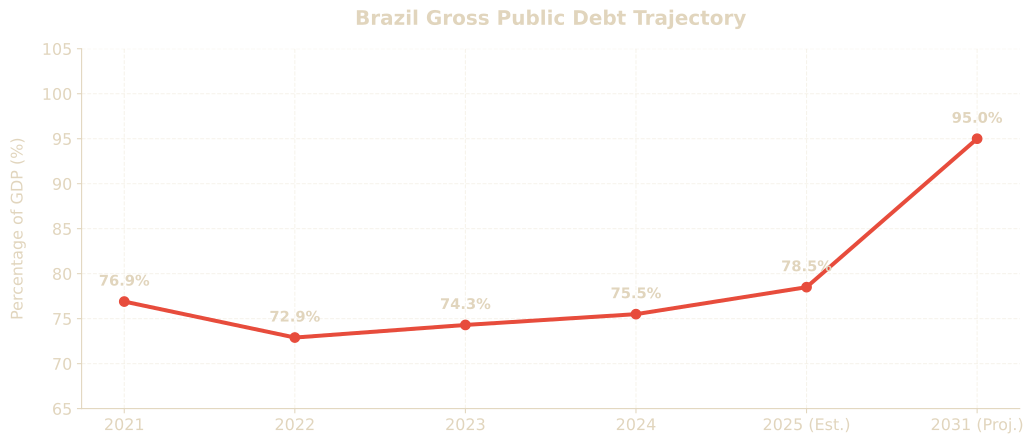
In the landscape of emerging economies, Brazil represents a fascinating and complex case study. On one hand, the country boasts extraordinary natural wealth, serving as an agricultural and energy superpower with a resilient domestic market; on the other hand, it has historically struggled with structural fragility in its public accounts. Today, the trajectory of state indebtedness—with gross public debt hovering stably around or above 80% of GDP and medium-term projections pointing upward—is pushing the macroeconomic system toward a friction point that demands rigorous analysis.
1. The Trajectory of Indebitamento and the Risk of Fiscal Dominance
If the state continues to increase its borrowing at the current pace, financial markets react rapidly by driving up the risk premium. This dynamic triggers a predictable chain reaction:
Upward Pressure on Interest Rates (Selic Rate): To compensate for a lack of market confidence and curb inflationary pressures driven by uncertainty, the Banco Central do Brasil (BCB) finds its hands tied. The forced response is to keep interest rates at restrictive levels for a prolonged period. This makes credit prohibitively expensive for the real economy and exponentially increases the cost of servicing public debt itself.
Volatility and Depreciation of the Real (BRL): An unstoppable debt burden erodes confidence in macroeconomic stability, accelerating foreign capital flight during global risk-off phases and fueling imported inflation.
The Crowding-Out Effect: By issuing government bonds with attractive yields to cover the deficit, the state crowds out the private sector, draining liquidity from domestic banks and funds that prefer risk-free public paper over corporate lending and infrastructure investments.
In this scenario, Brazil risks slipping into a regime of fiscal dominance—a condition where monetary policy loses effectiveness because every rate hike further worsens public accounts, fueling a self-fulfilling cycle of distrust.
2. Budget Composition and the Anatomy of Public Spending
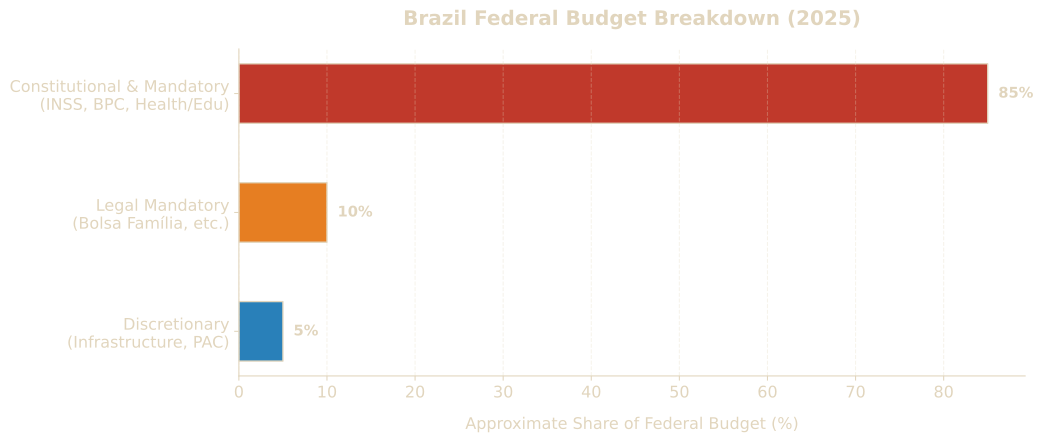
To understand where Brazil’s true structural bottlenecks lie, we must analyze how the federal budget is composed and strictly categorized by spending types:
Constitutional & Mandatory Spending (80%–90% of the budget): This represents the overwhelming, protected bulk of the budget. It includes INSS pensions, the Benefício de Prestação Continuada (BPC), fixed salaries for public servants, and constitutionally earmarked minimums for public health (SUS) and education. Modifying these requires complex constitutional amendments (PEC).
Legal Mandatory Spending (Over R$ 150 billion): Large-scale social programs such as Bolsa Família. While not constitutionally protected (they can be modified via ordinary law), their financial mass is massive—surpassing the state’s entire discretionary spending—and politically shielded by popular consensus.
Discretionary Spending (10%–20% of the budget): The sole flexible slice where the government can directly cut or freeze funds during fiscal crises, including infrastructure investments (PAC), ministry operations, and parliamentary amendments (emendas parlamentares).
Debt Service and Interest Payments (Hundreds of billions of R$): The financial expense tied to servicing accumulated government bonds, which spikes dramatically when the Central Bank is forced to maintain high interest rates.
Constitutional Transfers to Local Governments: Automatic percentage flows drawn from major federal tax revenues and transferred directly to States and Municipalities (FPE/FPM) by legal mandate.
3. The Pension Paradox: Why a "Young" Nation Spends Like an Aging Society
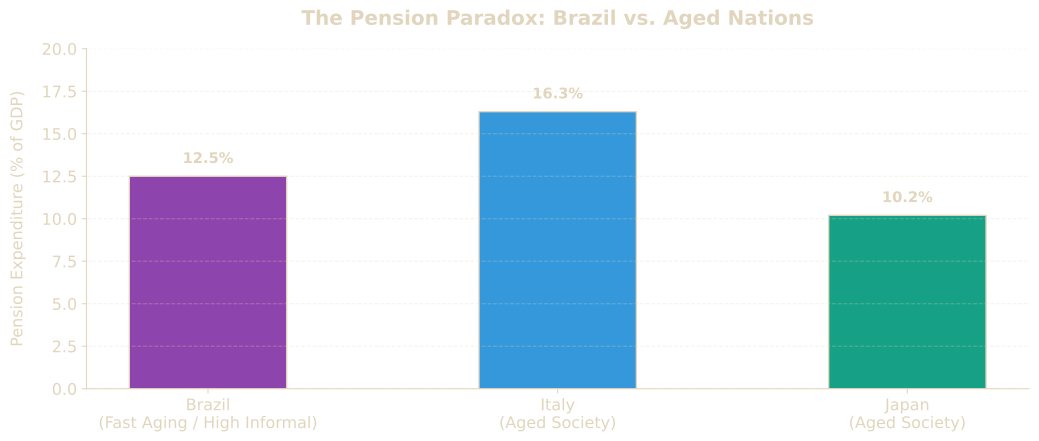
Within constitutional spending, the social security system (INSS) represents the primary fiscal black hole (allocating over R$ 1 trillion). The true economic paradox of Brazil lies in the fact that the country spends percentages of GDP on pensions comparable to those of demographically aged nations (such as Italy or Japan), despite retaining a comparatively young population.
Historical Distortions: Until the structural reform of 2019, Brazil allowed retirement without a mandatory minimum age, relying solely on contribution time (30 years for women, 35 for men). Millions of workers retired in the prime of their working lives (between 45 and 54 years old), enjoying decades of life expectancy funded by the state. This was compounded by privileged civil servant regimes and the automatic indexation of benefits to the minimum wage.
Accelerated Demographic Transition: Fertility rates have plummeted sharply, and the country is aging at a record pace. In a context marked by high labor market informality (with millions operating in the shadow economy without regular contributions), the tax base supporting the system shrinks, forcing the state to cover chronic, massive pension deficits through borrowing.
4. Public Spending Cuts: Objectives, Methods, and Necessity
To break this downward trend and create the macroeconomic conditions for the BCB to launch a robust rate-cutting cycle in the medium term, markets and economic theory agree on the need for structural spending consolidation. A credible fiscal adjustment requires a primary surplus savings estimated between 1% and 1.5% of GDP annually (roughly R$ 110–170 billion).
However, targeting the 10–20% discretionary slice or relying solely on administrative crackdowns on social program fraud (pente-fino) yields only temporary, insufficient relief. Rigid constitutional and pension spending absorbs virtually all state resources before the Executive can allocate funds for development.
5. Conclusion: The Ultimate Test for Brazil's Future
Brazil's long-term stabilization cannot rely solely on increasing tax revenues or introducing new levies, which would ultimately strangle the private sector and suppress GDP growth.
The true test for Brazil’s leadership lies in its political courage to tackle the hazardous terrain of structural reforms targeting rigid primary and pension spending. Only through a deep rationalization of mandatory spending mechanisms can the country sustainably lower its risk premium, loosen the grip of restrictive monetary policy, and transform its immense economic potential into stable, long-lasting wealth.