Beyond the Dollar Myth: How US Debt Dictates Brazil's Economic Paradox
At a Glance
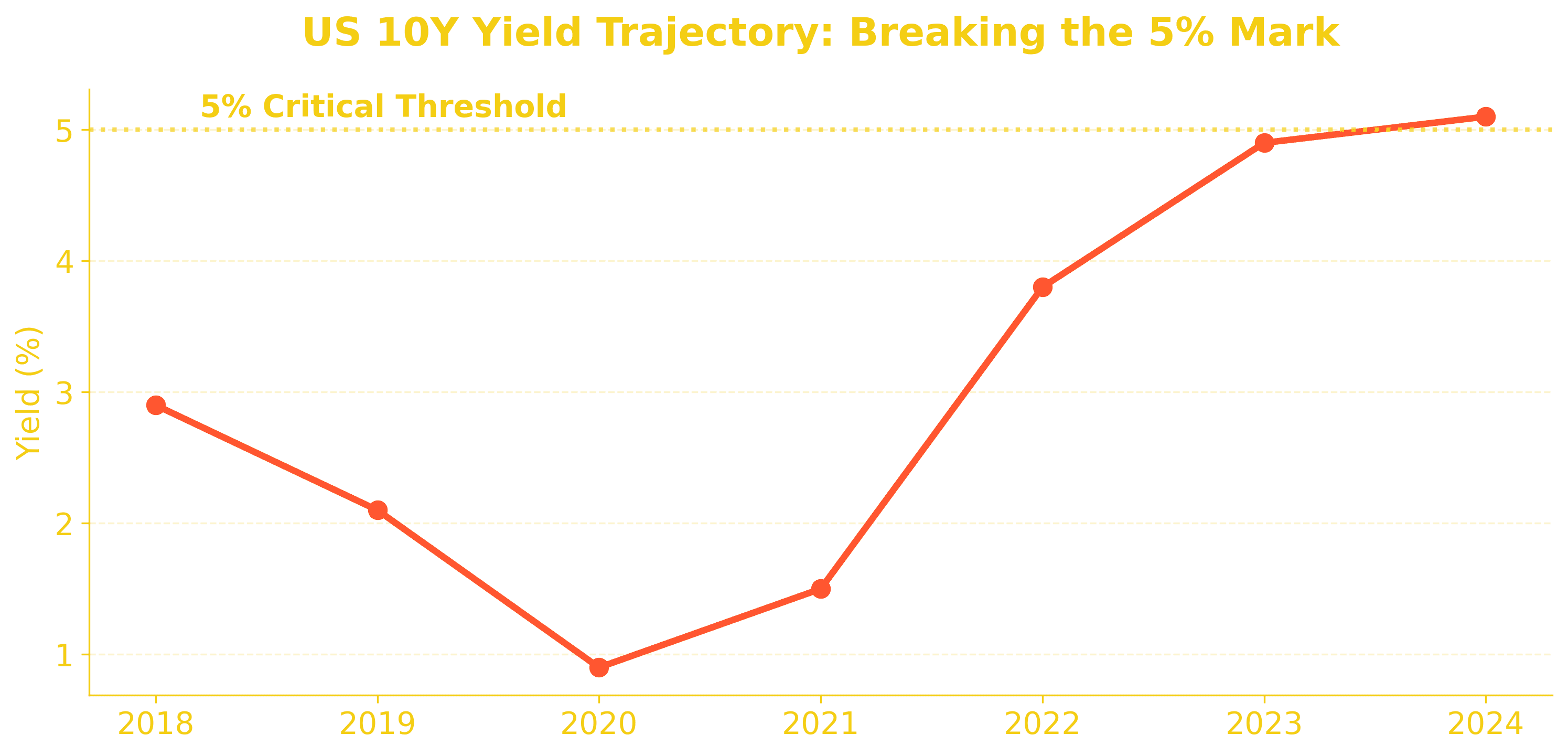
The breach of the 5% threshold on US Treasury yields is not a mere market fluctuation: it is the symptom of an American debt load on mathematically unpayable trajectories, actively undermining the absolute certainty of the Dollar. As the greenback loses its status as the "universal safe asset," global capital is repositioning. Brazil finds itself in the trenches: its solid exports and geopolitical neutrality shield it from a currency collapse, but to defend against the "vacuum cleaner" effect of US rates, it is forced to maintain suffocating domestic rates. This global defense effort exposes Brasília's true vulnerability: a private sector strangled by the cost of credit and a State paralyzed by constitutionally untouchable pension spending.
1. The Twilight of the Safe Dollar and the New Emerging Markets Map
The global financial system is undergoing an unprecedented realignment. The United States continues to issue massive volumes of sovereign debt to finance expanding deficits. The result is the risk of Debasement: the perception of fiscal unsustainability is eroding the historical role of the Dollar. While it remains the global settlement currency, it is no longer the infallible safe haven it once was.
Adding to this is a geopolitical fracture. The recent freezing of assets in international jurisdictions sent an unequivocal signal to sovereign wealth funds, pushing them to diversify their reserves away from the US and toward politically neutral jurisdictions.
This forced decoupling has changed the rules of the game. Historically, US rates over 5% triggered a systemic collapse of all emerging market currencies. Today, the reaction has fractured, rewarding those with the macroeconomic fundamentals to resist the Dollar:
Brazil: Central Bank Rate at 13.50%-14.00%. Strong surplus driven by agribusiness. Currency vulnerability to US shocks: Low (exchange rate anchored to real fundamentals).
India: Rate at 6.50%. Trade deficit (importer). Vulnerability: Moderate (defended by ample reserves).
South Africa: Rate at 8.25%. Narrow surplus. Vulnerability: High (heavily exposed to capital outflows).
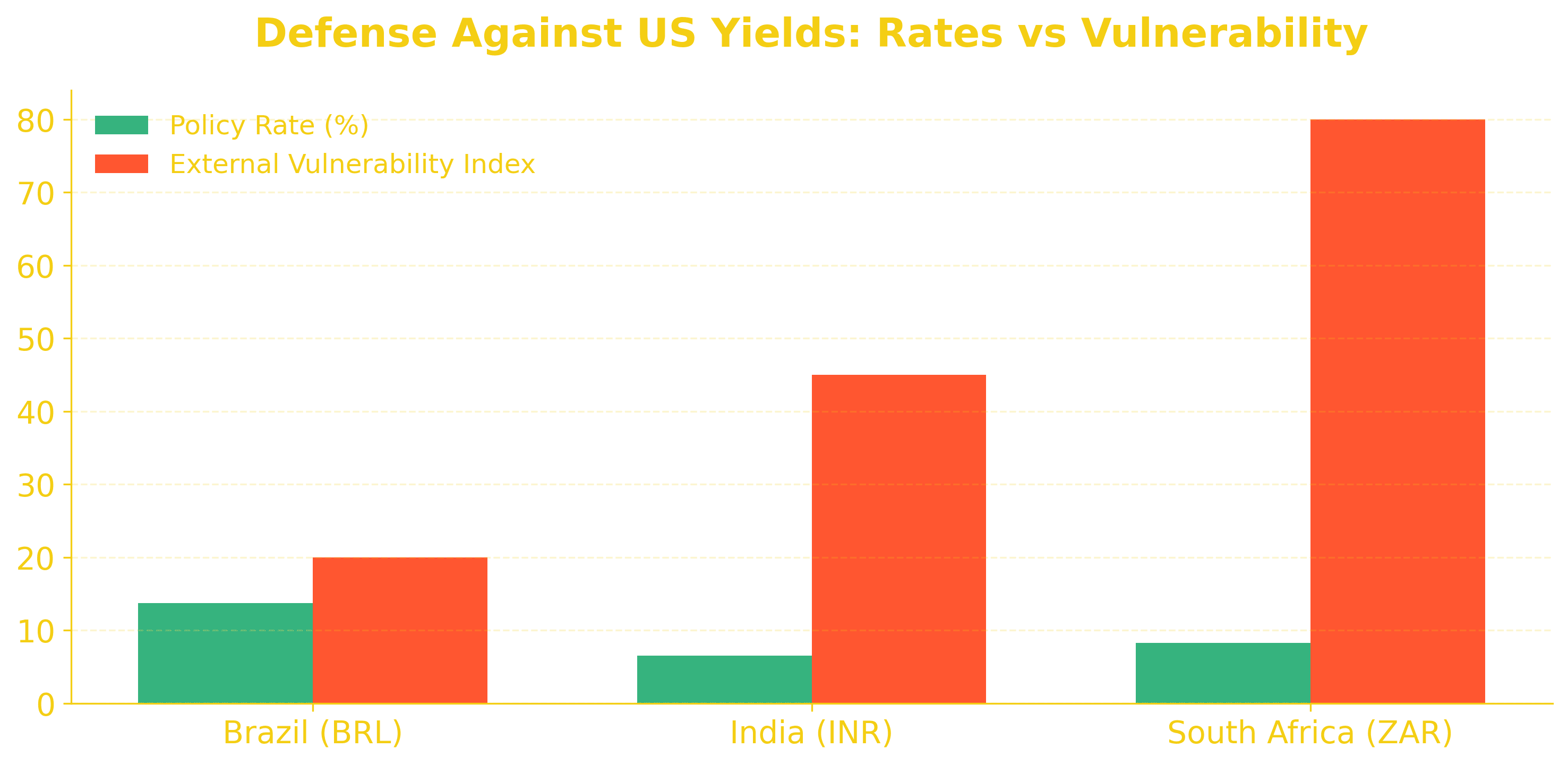
The Brazilian Real (BRL) is not collapsing in the face of US debt because it has evolved into a commodity-driven currency, protected by a massive trade surplus and real sovereign rates above 8%.
2. The Global Vacuum Cleaner and the Sacrifice of Brazil's Private Sector
However, resisting the fatal attraction of 5% US Treasuries exacts a devastating domestic toll. To prevent capital flight to the US, the Banco Central do Brasil is forced to erect a financial fortress, holding the Selic rate around 14%. Brazil is defending its currency from the Dollar's decline by sacrificing its own real economy
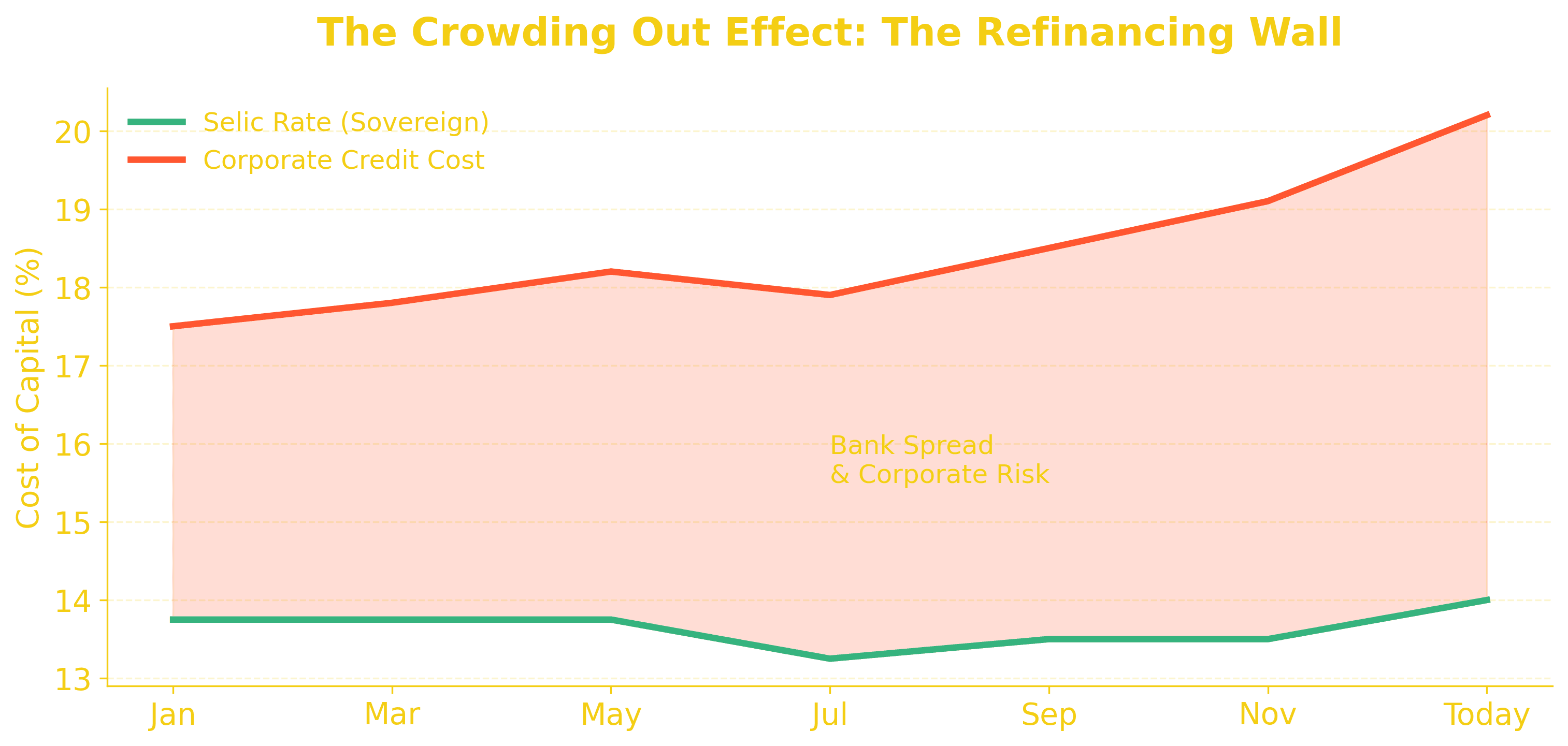
The immediate effect is Crowding Out. Brazilian banks and institutions prefer to liquidate corporate credit (debentures) to take refuge in local government bonds, which offer extremely high, risk-free yields. The result? While US debt dictates global rates, Brazilian companies face a real cost of credit that, factoring in bank spreads, skyrockets to 17-20% annually. Under these conditions, construction sites halt, operating margins are wiped out, and the private refinancing market is paralyzed.
3. The Fiscal Cage: Why Brazil Cannot Ignore the US
Why doesn't Brazil simply lower rates, decoupling from the American grip to save its businesses? Because the high tide of global rates exposes a domestic fiscal sinkhole. Cutting the Selic would trigger a currency panic due to an extremely rigid state budget structure: between 80% and 90% of Brazil's primary spending is mandated by the Constitution.
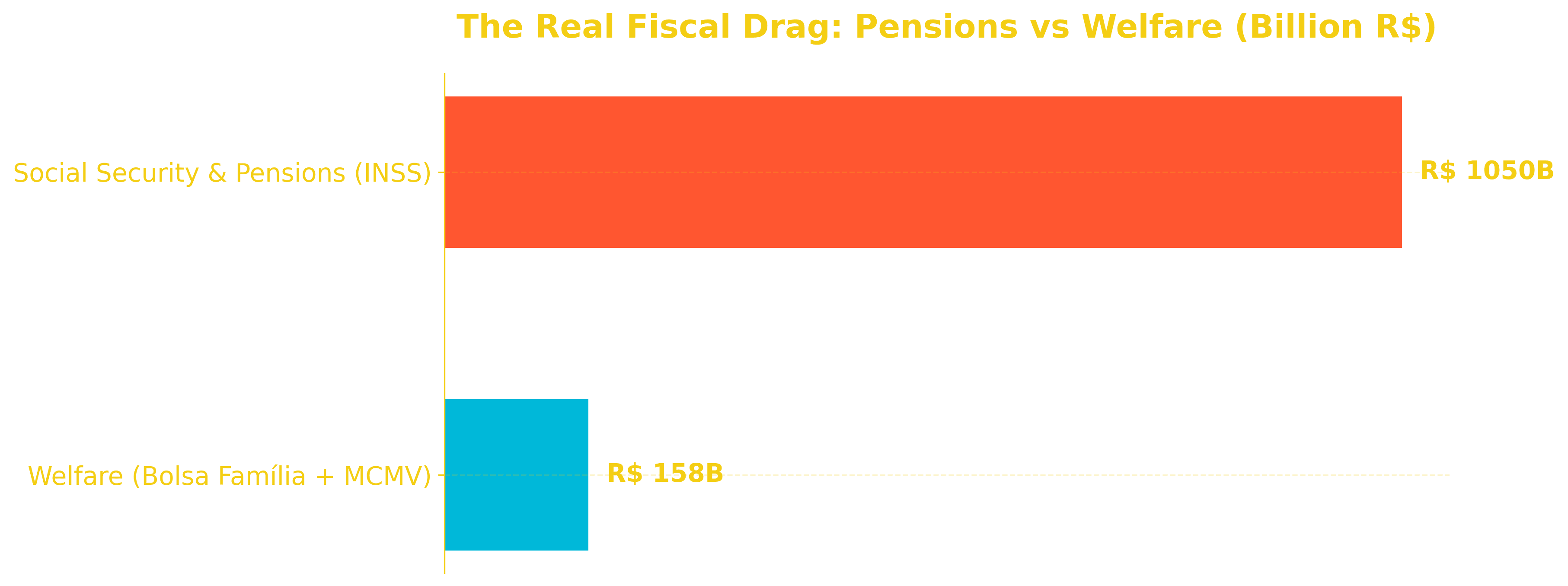
The true black hole preventing independence from US rates is the social security system (INSS). Despite a relatively young demographic profile, Brazil spends a percentage of its GDP on pensions comparable to rapidly aging nations like Italy or Japan. This system—absorbing over 1 trillion reais annually, the legacy of early retirements and fixed minimum-wage indexation—generates a chronic structural deficit. It is this constitutional untouchability that forces the State to continuously issue debt, leaving it highly vulnerable to rate shocks decided in Washington.
4. The Welfare Multiplier: A Macroeconomic Miscalculation
In an attempt to find resources to lower the debt and better defend against the Dollar, fiscal hawks often point the finger at non-constitutional programs, such as Bolsa Família (which, alongside programs like Minha Casa, Minha Vida, costs about 158 billion reais per year).
Yet, in a scenario where the strong Dollar asphyxiates private corporate credit, cutting welfare would be macroeconomic suicide. These cash transfers have a vital countercyclical function:
High propensity to consume: Resources go to vulnerable demographics that spend them immediately in the real economy, keeping aggregate demand and domestic retail afloat.
Instant tax return: This consumption generates immediate tax revenue through indirect taxes (ICMS), partially self-financing the government's outlay.
The structural problem in the face of international shocks is the pension system, not social welfare, which remains the last running engine of the Brazilian economy.
5. Strategic Outlook in the Shadow of US Debt
Until the United States resolves the riddle of its fiscal trajectory and Dollar debasement, Brazil will have to live with this defensive credit crunch. This scenario opens up highly polarized market dynamics:
Tail Risks: Mid-market companies, highly indebted and unable to withstand 20% rates, will run out of liquidity. We will see a surge in recuperação judicial (Chapter 11-style bankruptcies) and a total freeze on industrial and real estate CapEx.
The Silver Linings: Cash is king. Large commercial banks will see their net interest margins (NIM) expand thanks to the primary market freeze. Simultaneously, well-capitalized exporting entities (which earn in hard currency) will have the opportunity to launch aggressive M&A campaigns, acquiring struggling domestic competitors at historically compressed valuation multiples.