The Banco Master Collapse and Private Credit Contagion
At a Glance
Analyzing the Brazilian economy is incomplete without accounting for institutional risk, commonly known as the "Custo Brasil." Even when macroeconomic variables are perfectly aligned and yield rates attract international capital, regulatory fragility and corruption can disintegrate market confidence within days, forcing a severe repricing of assets.
The peak of this systemic fragility occurred between 2025 and 2026 with the collapse of Banco Master, identified as the largest banking fraud against the Brazilian National Financial System in the last two decades.
Analyzing the Brazilian economy is incomplete without accounting for institutional risk, commonly known as the "Custo Brasil." Even when macroeconomic variables are perfectly aligned and yield rates attract international capital, regulatory fragility and corruption can disintegrate market confidence within days, forcing a severe repricing of assets.
The peak of this systemic fragility occurred between 2025 and 2026 with the collapse of Banco Master, identified as the largest banking fraud against the Brazilian National Financial System in the last two decades.
The Mechanics of the Fraud and the Yield Trap
The crisis originated from an unsustainable business model based on creating and selling credit portfolios devoid of real financial collateral to the Banco de Brasília (BRB). To conceal the capital deficit and attract retail liquidity, Banco Master offered out-of-market fixed yields, proposing Bank Deposit Certificates (CDBs) at 140% of the CDI rate.
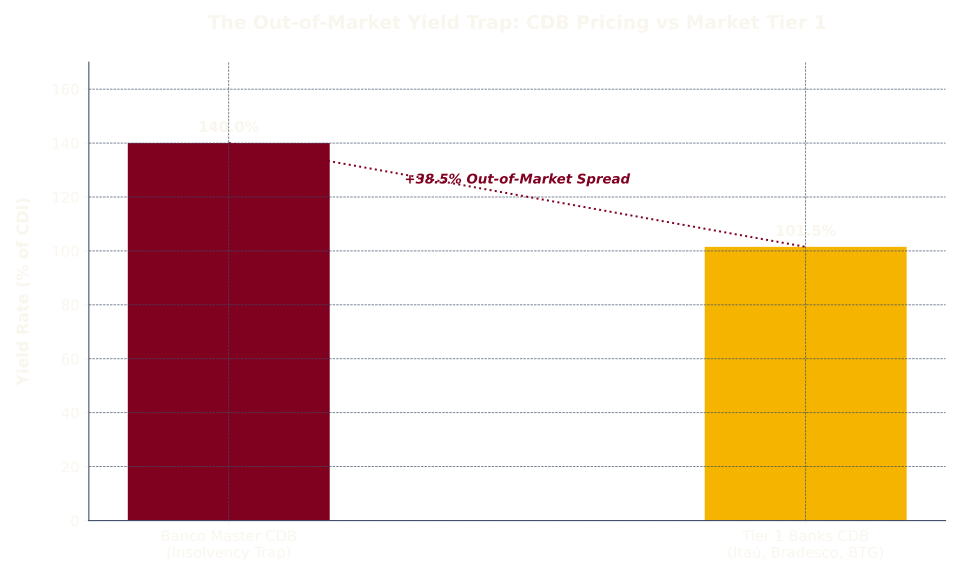
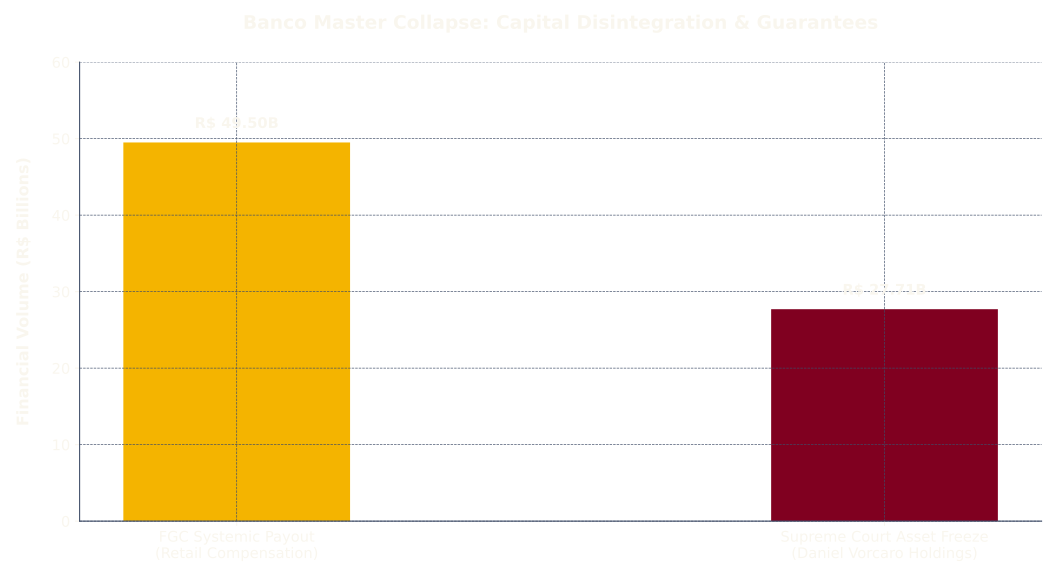
This mathematical unsustainability led the Central Bank of Brazil (BCB), in November 2025, to decree the extrajudicial liquidation of the entire conglomerate. The impact on the guarantee system was colossal:
FGC: The Credit Guarantee Fund (FGC) was forced to inject 49.5 billion BRL (approx. 9.3 billion USD) in compensation, draining systemic liquidity.
Assets: The Supreme Court froze assets valued at 27.71 billion BRL (approx. 5.2 billion USD).
Institutional Contagion: Operation "Compliance Zero"
The most serious repercussions, capable of altering country risk, were of a political and institutional nature. The Federal Police’s "Compliance Zero" investigation, reaching its sixth phase in mid-May 2026, uncovered a fraudulent network weaving together financial crime, private militias ("The Posse"), and high-level public officials.
Investigations revealed that the bank's owner, Daniel Vorcaro, utilized corrupt ties to protect toxic operations:
Central Bank and BRB: Former heads of the BCB’s Banking Supervision were suspended, while the former BRB president is accused of facilitating transactions for 146.5 million BRL (approx. 27.6 million USD) in bribes.
Legislative Power: Senator Ciro Nogueira is accused of receiving monthly payments in exchange for attempting to introduce the "Master Amendment," a law drafted by the bank's own advisors to increase FGC coverage from 250,000 BRL (approx. 47,000 USD) to 1 million BRL (approx. 188,000 USD).
Presidential Race: The reputational crisis peaked with proof linking Vorcaro to presidential pre-candidate Flávio Bolsonaro, involving transfers of tens of millions of BRL to finance "Dark Horse," a Hollywood production intended for political propaganda.
Market Paradox: Complacency or Resilience?
The spread dynamics in 2025 revealed a revealing pattern. In mid-October, the market reacted with a sudden spike in risk aversion, clearly correlated to the first signs of Banco Master’s insolvency. This spike, while caused by a systemic fraud, lasted just over a week before quickly receding. It is significant to note that the magnitude of this shock was comparable to that observed in June 2025, when the spread experienced similar pressure due to exogenous macroeconomic factors, such as uncertainty regarding the fiscal trajectory and the repricing of US Treasuries.
The fact that the collapse of a private institution generated a market impact identical to that produced by far more recurring and "normalized" macroeconomic turbulence offers an analysis of nontrivial insight: the system's capacity to absorb idiosyncratic risk without suffering a permanent fracture. This reaction indicates a "normalization" of risk: the market has accepted Banco Master as an acute event, not a systemic pathology.
This signal of resilience, however, should not lead to apathy. If the system has demonstrated the ability to contain technical contagion — thanks primarily to trust in mechanisms like the FGC and the responsiveness of the Central Bank — the unknown remains the sustainability of institutional quality when the "permeability" between finance and politics becomes this deep. The thesis is not that the system is infallible, but rather that it has shown surprising technical resilience, despite a political fragility that remains the true, major structural risk to be monitored.
Operational Implications
This inextricable link between fraudulent high finance and political power triggers a massive risk premium for foreign investors. For institutional or private European capital, the operational implication is categorical: the extreme "reach for yield" in the unregulated private market exposes investors to a concrete danger of capital annihilation. Allocation in Brazilian bank credit remains highly profitable, but must adhere to two ironclad rules:
Selection: Limit exposure exclusively to primary institutions (Tier 1 such as Itaú, Bradesco, or BTG Pactual).
Protection: Keep individual positions strictly within the 250,000 BRL (approx. 47,000 USD) ceiling guaranteed by the FGC, thus immunizing the portfolio from any peripheral entity failure.